
Refractive lens exchangeSaginaw, Michigan
The fix for reading glasses isn’t a stronger pair.
Refractive lens exchange replaces the lens that’s stiffened with age, so you lean on readers a lot less.
Dr. Melanie Mihlstin, MD · Board-certified eye surgeon
Free · With Dr. Mihlstin personally · For adults over 45
5.0139 Google reviews
What our patients say.
5.0139 Google reviews · powered by Google

MiVision is very welcoming. Everyone is friendly. Dr Mihlstin is very thorough and takes her time and answers all your questions. Plus there is a nice coffee room!
Read on GoogleI had cataract surgery with Dr. Mihlstin and the entire experience was outstanding…

Dr Mihlstin and all the staff are great! I had such a pleasant experience with everyone both at the office and Towne Centre. Very caring staff along with a laugh or 2. Thank you so much! 2 days after 2nd eye and I see great!
Read on Google…Even though i have a huge phobia about having anything by my eyes, they made me feel completely comfortable.

Great practice. Treats you like a real human. Everyone is so friendly. Waiting room for my husband was so nice. I wish everyone would go there.
Read on Google1 of 5
Free vision assessments with Dr. Mihlstin are limited each week.
She sees a set number of new patients each week, so every visit gets a full set of measurements.
Refractive lens exchange was made for three kinds of people.
Your readers keep getting stronger.
Plus one, then a step stronger every few years. The reason is inside your eye.
You live in progressives.
Chin up, eyes down, hunting for the one sharp strip. A wider-range lens does that work for you.
You’ve been farsighted since you were a kid.
Past forty-five, farsighted eyes are often an especially good match for lens replacement.
Why your readers keep getting stronger.
In your forties, the lens inside your eye stiffens, like a hinge that won’t swing freely. Glasses can’t loosen it, so each new pair of readers is just stronger.
- +1.00Mid-40s
- +1.50Around 50
- +2.00Mid-50s
- +2.50Around 60
Refractive lens exchange fixes the lens itself. Dr. Mihlstin replaces it with one chosen from your measurements.
Where the new lens goes.
The old lens comes out. A new one goes in the same spot.
Schematic — not to scale.
The front of your eye stays as it is.
Your cornea isn’t reshaped.
The old lens comes out through a tiny opening.
In small pieces, just as in cataract surgery.
The new lens goes in the same spot.
It unfolds where your old lens was, designed to stay for life.
Which lens? That depends on your day.
Dr. Mihlstin asks what you look at most: your phone, your computer, the road.
Sharpest distance
Crisp driving, night included. Readers for small print.
Distance through arm’s length
Road, dashboard and computer. Readers for fine print.
Distance down to your phone
The most range, the fewest readers. Night halos are more common while you adjust.
Each also comes in a version that corrects astigmatism.
Meet Dr. Melanie Mihlstin, MD
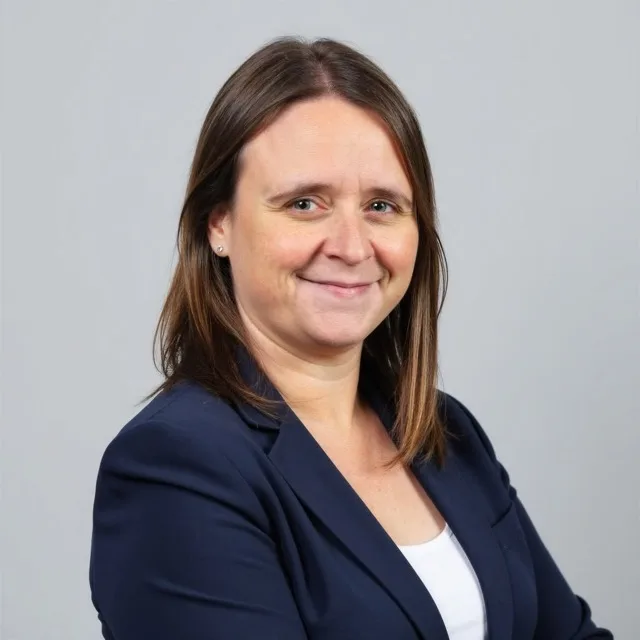
Board-certified ophthalmologist. Founder of MiVision Eye Care.
- Board-certified
- Wayne State MD
- Kresge Eye Institute
- Saginaw since 2019
- Michigan Tech engineering
Born in Royal Oak, raised in Lapeer, trained as a biomedical engineer before medicine. Lens surgery is the foundation of MiVision. She also performs EVO ICL, LASIK and PRK, so the recommendation starts with your eyes.
“I perform EVO ICL, LASIK and lens replacement, so I have no reason to steer you toward any one of them. The recommendation fits your eyes.”
Her measurement standard.
Before I recommend a lens, I measure:
- The length of your eye
- The curve of your cornea
- Your retina
- Your pupils in the dark
- The surface of your eye (dry eye skews the numbers)
“If any of those numbers is off, I'll tell you no.”
The same operation as cataract surgery, done before a cataract forms.
cataract operations a year in the U.S. Same operation, on a clear lens.
an eye. A couple of hours, start to finish.
Many see better in a day or two, back at a desk in about three.
Designed to stay. It doesn’t wear out.
An age-related one can’t form in that eye. A later haze clears with a quick office laser.
patients in the FDA trial of the PanOptix trifocal lens reported never needing glasses. Those were cataract patients, and results vary by lens.
Lenses are FDA-approved for use after cataract removal; using one on a clear lens is an off-label use Dr. Mihlstin explains at your visit. Refractive lens exchange is real surgery: every eye carries some risk, and not everyone is a candidate. Individual results vary. PanOptix is a trademark of Alcon.
LASIK is a great procedure. Past 45, the question is where the problem lives.
For the right eyes, LASIK is exactly what she recommends.
| Measure | Refractive lens exchange | LASIK |
|---|---|---|
| What it works on | The lens inside your eye | The front of your eye, the cornea |
| Your natural lens | Replaced with a new one | Stays, and keeps changing with age |
| Reading up close | Lenses with more range cover near and far | Often handled with monovision, one eye set for near |
| A cataract later | Can’t form in that eye | Still possible with age, as for anyone |
| Usually suits | Eyes past 45, especially farsighted ones | Eyes before the natural lens starts to stiffen |
| Procedure time | About 15–20 minutes an eye | About 15 minutes |
Nearsighted, in your 40s or 50s? The EVO ICL may fit better. She does all three; your measurements decide.
From “maybe” to a straight answer in four steps.
Pick a time below.
Two minutes. The office calls to confirm.
Your free vision assessment.
Everything measured, plus how you use your eyes.
A straight answer, in writing.
Lens exchange, EVO ICL, LASIK, or wait. Plan and price in writing.
Procedure day.
About 15–20 minutes an eye. Numbing drops, pressure, not pain.
Questions people actually ask.
Is this the same as cataract surgery?
Yes. Same operation, same kind of FDA-approved lens. Yours is just still clear, so it’s elective.
Does it hurt?
Numbing drops and usually a mild sedative. Pressure and a bright light, not pain. Scratchy for a day or two.
Am I a candidate?
Usually over 45 and relying on readers or progressives. Farsighted eyes are often a strong match. Very nearsighted eyes need a careful retina check, and sometimes the EVO ICL fits better. The assessment decides.
Will I still need reading glasses?
It depends on the lens. With wider-range lenses, most study patients rarely reached for readers. With a single-focus lens, readers stay for close work.
Will I see halos at night?
Wider-range lenses can bring rings around lights. For most they fade within months, not for everyone. Drive a lot at night? That shapes which lens she picks.
Can I still get a cataract later?
Not an age-related one in that eye. A thin haze can form years later; a quick office laser clears it.
I had LASIK years ago. Can I still have it?
Often, yes. Bring your pre-LASIK prescription if you can find it.
How much does it cost? Does insurance help?
It’s elective, so insurance doesn’t cover it. Your exact price goes in writing at your visit. Most pay monthly, and HSA and FSA dollars work.
How fast is recovery?
Many see better in a day or two and are back at a desk in about three. Wider-range lenses keep improving for a few months.
What are the risks?
It’s real surgery inside the eye, so every eye carries some risk. Serious complications are uncommon. The one she screens for most carefully is retinal detachment, which is more likely in very nearsighted eyes, and it’s one reason everything gets measured first.
Claim your free vision assessment with Dr. Mihlstin.
Pick a time. The office will call to confirm.
Prefer to call? (989) 321-2655
Free · No obligation · Your information stays private.
Where to find us
Loading map…
5310 Hampton Place, Suite 1, Saginaw, MI 48604
Patients drive in from Midland, Bay City, Frankenmuth and the Thumb. Most are here in under an hour.
Open in Google Maps →